Once upon a time, a toll-free number was the sound of trust. Those familiar “0800” or “1-800” prefixes meant that you could reach a business without paying a cent. Before chatbots and customer portals, the voice was the ultimate handshake, and toll-free numbers became the symbol of credibility.
Fast-forward to today, and communication has fractured into dozens of digital touchpoints such as apps, chats, bots, and AI assistants. Yet, the call still holds emotional currency, given that voice builds trust in ways pixels never can. However, the infrastructure carrying those calls is due for a serious upgrade.
Across Africa and beyond, toll-free numbers are being reinvented as cloud-powered VoIP systems that are smarter, faster, and more insightful.
This article explores that transformation and how providers like Telvoip are helping businesses modernize voice infrastructure to keep customer calls human, data-driven, and trustworthy in the digital age.

The Legacy Era of Toll-Free as a Symbol of Credibility
The toll-free story began in 1967, when AT&T introduced the first toll-free service. For the first time, customers could call businesses without incurring charges. The “1-800” prefix soon became synonymous with convenience and care, a psychological signal that brands valued their customers’ time and money.
Why Toll-Free Worked
- Trust: Free-to-call lines projected reliability and professionalism. They reassured customers that the brand was established, transparent, and reachable.
- Accessibility: Businesses could connect with customers across regions, breaking geographical and socio-economic barriers.
- Brand reputation: Having a toll-free number was a mark of legitimacy and customer-first culture. For large enterprises, it became a status symbol of service excellence, while for smaller companies, it was a gateway to scale.
In essence, toll-free communication was the pre-internet version of brand engagement. It allowed voice to become the bridge between customers and corporations, creating a personal, direct, and emotional channel that built long-term loyalty. But like most legacy systems, its brilliance came with blind spots.
The Hidden Constraints of Legacy Toll-Free
Behind the reassuring ring of every toll-free call was a hardware-heavy ecosystem: private branch exchanges (PBX), copper phone lines, and carrier-dependent routing. These systems were powerful for their time but lacked flexibility.
- Hardware dependency: Each call had to pass through physical exchanges, meaning outages, limitations, and costly upgrades were part of the deal.
- Scalability issues: Growth came with friction as expanding into new regions required laying new lines or contracting with multiple telecom operators.
- No analytics: Businesses could measure call volumes, but not why customers were calling, how long they stayed on the line, or whether the conversation led to a sale or resolution.
- High maintenance costs: Legacy toll-free systems demanded ongoing investments in hardware, maintenance, and routing, which was a significant burden for enterprises trying to modernize.
For decades, these constraints were hidden beneath the surface. The voice worked, so few questioned how it worked. But as communication evolved beyond the phone, the system’s rigidity became impossible to ignore.
The Turning Point: When Voice Met Cloud Telephony
The 2010s brought a wave of transformation, and businesses no longer operated in silos, they thrived on platforms, and not just phones.
The customer journey shifted from linear (call → resolve → hang up) to dynamic (chat → email → call → social → call again).
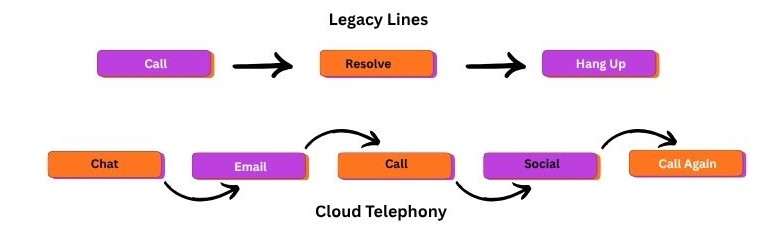
Suddenly, legacy toll-free systems couldn’t keep up because they were disconnected from customer relationship management (CRM) platforms, chatbots, and analytics dashboards. Calls remained black boxes that were valuable but invisible to data-driven decision-making.
This resulted in an experience gap, where toll-free remained static while other channels became smarter.
Why Legacy Lines Needed Reinvention
The modern customer doesn’t just call, they chat, text, email, and switch devices in seconds. Businesses, in turn, need to track and optimize every interaction across these channels.
This shift has fundamentally changed what “toll-free” means. Businesses no longer want a line that simply rings, they want a system that learns.
The Forces Driving Reinvention
- Omnichannel expectations: Customers now expect seamless movement between chat, voice, and digital channels. A query started on social media should continue smoothly on a call, with no repetition or friction.
- Analytics pressure: Boards and CMOs demand proof of value. Every call must justify its cost, from lead generation to resolution rates.
- Cost efficiency: Maintaining legacy PBX hardware and telecom dependencies is expensive and inflexible, especially when cloud-based VoIP offers scalability at a fraction of the price.
- Pandemic acceleration: Remote work exposed the limitations of on-premise telephony. Companies needed flexible, cloud-native systems that could support distributed teams and virtual contact centers.
The question has shifted from whether toll-free still matters to how it can be modernized. The human voice remains the strongest signal of trust, but it now needs smarter, more connected systems to carry it forward.
Rather than abandoning toll-free, the path lies in evolving it through smart VoIP; the new backbone of toll-free communication where every call becomes a data event and every conversation adds to customer intelligence.
Providers like Telvoip are driving this transformation, enabling businesses to merge voice, data, and automation into seamless, secure, and insight-driven customer interactions.

Understanding Smart VoIP as The New Backbone of Toll-Free
Smart VoIP combines toll-free routing with cloud infrastructure, AI, and real-time analytics. It’s a digital transformation of the traditional voice system, maintaining the same customer accessibility but empowering businesses with intelligence and automation.
Core Features of Smart VoIP
- Cloud-based call routing: Calls no longer depend on physical lines or local exchanges. Smart VoIP operates entirely in the cloud, offering instant scalability and global reach. Businesses can add or reroute lines within minutes, whether it’s a startup expanding into new markets or a bank handling seasonal call surges.
- IVR and virtual agents: Interactive Voice Response (IVR) systems and AI-powered assistants now handle first-level interactions, freeing up human agents for complex cases. Callers are greeted by context-aware menus that recognize intent and language, cutting wait times while maintaining personalization.
- CRM integration: Every call syncs automatically with customer profiles in systems like Salesforce, HubSpot, or Freshdesk. When an agent picks up, they already see the caller’s history, past tickets, and preferences, ensuring continuity and informed responses.
- Language and geographic routing: Calls can be intelligently directed to the nearest or most relevant agent, not just based on location but also on language and expertise. For businesses across Africa’s multilingual markets, this creates instant familiarity and trust.
- Speech analytics: AI tools now analyze tone, emotion, and keywords during live conversations. Managers can gauge satisfaction levels, detect frustration, and even flag compliance risks in real time.
- Call recording and compliance: Built-in storage, encryption, and audit trails ensure every call is securely logged for training, quality assurance, and regulatory compliance. This is especially vital in sectors such as finance, healthcare, and telecommunications, where call-recording and monitoring enhance service quality and accountability.

How Smart VoIP Works
Think of Smart VoIP as the cloud-native upgrade to the traditional PSTN (Public Switched Telephone Network), the digital highway replacing the analog road.
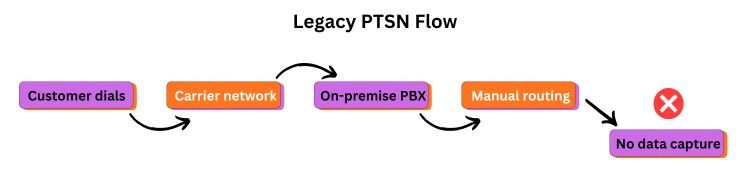
Legacy PSTN flow:
Customer dials → Carrier network → On-premise PBX → Manual routing → No data capture
This process was functional but blind since it connected voices without context and ended once the call dropped.
Smart VoIP flow:
Customer dials → Cloud router → AI/IVR triage → CRM sync → Real-time analytics → Automated reporting
Each stage adds intelligence, so the system not only connects the call but also understands it. It captures data, updates records, and generates insights as the conversation unfolds.
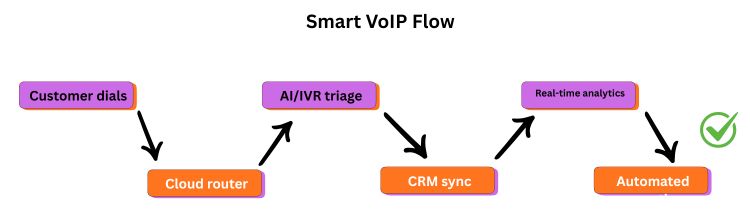
This architecture means a call from Nairobi to a customer support center in Lagos can be routed through a global cloud network, analyzed for sentiment, logged in the CRM, and summarized in a performance dashboard within seconds.
Providers like Telvoip bring this architecture to life, offering cloud-native VoIP solutions with built-in AI routing, CRM integration, and analytics dashboards. With Telvoip, businesses gain visibility into every call, transforming voice interaction.
From Cost Center to Growth Channel: The Business Case for Smart Toll-Free
In the legacy era, toll-free numbers were viewed as an unavoidable expense, a customer service cost, not a growth lever. They helped manage inquiries and complaints but provided little in terms of insight or measurable ROI.
Today, with Smart VoIP, the toll-free line has evolved from a reactive support tool into a proactive engine of customer intelligence and revenue growth. The difference lies in data, where every call is now a datapoint that reveals customer intent, satisfaction, and conversion opportunities.
1. Analytics-Driven Decision Making
Smart Toll-Free systems are no longer blind spots in a business’s analytics stack. They now feed directly into CRM and business intelligence tools, enabling leaders to visualize voice interactions as performance metrics.
Every call can tell a story:
- Sentiment analysis detects tone, emotion, and urgency, helping identify at-risk customers or high-value leads.
- Keyword tagging reveals recurring pain points or popular product interests, informing marketing and product development.
- Conversion tracking connects calls to marketing campaigns, allowing brands to see which channels actually drive sales, not just clicks.
For executives, this means voice engagement finally earns its seat at the analytics table as a signal.
2. Enhanced Customer Experience (CX)
In a world where customer patience lasts seconds, Smart VoIP turns responsiveness into reputation. Intelligent routing ensures every call lands with the right department, cutting the endless “please hold” loops.
Virtual agents handle repetitive queries like balance checks, FAQs, and password resets, while live agents focus on high-touch interactions that build loyalty.
The result:
- Shorter wait times.
- Higher first-call resolution rates.
- 24/7 service continuity, even across time zones.
This blend of human empathy and digital efficiency turns every call into a brand-building moment, transforming customer experience into a powerful driver of revenue growth.
3. Scalable and Global
Scaling legacy toll-free lines once meant rewiring infrastructure and negotiating with carriers. With cloud-based Smart Toll-Free systems, expansion happens in clicks, instead of months.
Businesses can:
- Add or remove lines instantly, without new hardware.
- Deploy across regions with localized numbers that still feed into a unified system.
- Manage distributed teams through a single cloud dashboard, standardizing service quality worldwide.
For regional businesses; say, a Kenyan fintech expanding into Ghana or Nigeria, this model supports scalable growth while preserving local presence and brand consistency, aligning seamlessly with the economics of customer experience (CX).
4. Marketing Integration
Smart VoIP bridges a gap that marketers have long struggled with: proving the ROI of phone calls. With built-in tracking and attribution, businesses can pinpoint which campaigns or keywords drive inbound calls from Google Ads to billboards.
- Marketing teams can map voice interactions directly to conversions.
- Offline campaigns finally become measurable, as call data links back to digital CRMs.
- Cross-channel attribution ensures voice gets credit for its role in the sales journey.
This makes toll-free not just a service line, but a marketing analytics tool in its own right.

The African Fintech Case Example
Consider a regional fintech or insurance firm operating across Kenya, Nigeria, and South Africa. Using Smart Toll-Free, the brand can:
- Track customer onboarding efficiency, identifying where clients drop off in the KYC process.
- Analyze agent performance using recorded calls and AI-driven insights.
- Identify high-intent leads by linking call data to ad campaigns.
The company can even detect sentiment trends: for instance, spikes in frustration around app usability, and feed that data directly into product teams for improvement.
ROI and Competitive Impact
The results are quantifiable:
- 30–50% reduction in missed or abandoned calls.
- Up to 20% boost in agent productivity.
- Higher CSAT (Customer Satisfaction) and NPS (Net Promoter Score), driven by faster, more personalized engagement.
In short, Smart Toll-Free converts what used to be a silent cost center into a growth channel that learns, adapts, and scales, all while preserving the familiar trust of the 1-800 model.
What Technology Powers Smart Toll-Free?
Behind every Smart VoIP system lies a powerful ecosystem of technologies that transform ordinary phone calls into intelligent, measurable, and secure business interactions.
This infrastructure blends cloud telephony, AI, and data analytics, creating a communication network that doesn’t just connect people but learns from every exchange.
1. VoIP and SIP Trunking as the Foundations of Digital Voice
At its core, Smart Toll-Free replaces traditional analog lines with internet-based telephony through Voice over IP (VoIP) and Session Initiation Protocol (SIP) trunking.
This shift eliminates the need for on-premise PBX hardware and local carriers, giving businesses:
- Lower operational costs and reduced downtime.
- High-definition call quality, even in remote regions.
- Instant scalability, with new lines added through a dashboard instead of physical installation.
In essence, VoIP moves voice from copper to the cloud, freeing enterprises from infrastructure constraints while enhancing reliability and reach.
2. Making Voice Intelligent with AI and Natural Language Processing (NLP)
Artificial Intelligence is what gives Smart Toll-Free its “smart” edge. Through real-time transcription and natural language processing, AI systems analyze speech patterns, detect emotion, and understand caller intent.
These capabilities enable:
- Sentiment and urgency detection, identifying frustration or enthusiasm in real time.
- Agent assistance, where systems suggest next best actions or scripted responses.
- Automated quality assurance, flagging conversations that need follow-up or escalation.
AI effectively turns every voice interaction into a stream of data that can train better service and reveal hidden opportunities for customer engagement.
3. Turning Calls into Data Assets Using CRM and Automation Tools
The most powerful voice systems are not standalone, they’re integrated into CRM and automation tools. By linking with CRMs like Salesforce, HubSpot, or Zoho, Smart Toll-Free ensures that every call enriches customer profiles with real-time context.
Automation tools then:
- Log call summaries and update tickets automatically.
- Trigger workflows such as follow-up emails, callbacks, or marketing actions.
- Visualize voice insights alongside digital touchpoints for a unified view of the customer journey.
This closes the feedback loop, turning every conversation into a measurable input for marketing, sales, and customer success teams.
4. Keeping Conversations Seamless with Omnichannel APIs
Modern communication is never linear. A customer might start with a WhatsApp message, continue through email, and end up on a voice call.
Omnichannel APIs ensure that Smart Toll-Free systems maintain continuity across these channels.
- Customer context follows the interaction, regardless of platform.
- Agents see the full communication history before answering.
- Businesses deliver a coherent experience, not fragmented service.
Providers like Telvoip are making this possible through robust omnichannel APIs that unify messaging, voice, and data in one platform, helping businesses maintain seamless, personalized conversations that strengthen trust and loyalty in the digital-first economy.
5. Building Trust in Every Call Securely, and Compliantly
As voice data moves to the cloud, security and compliance become non-negotiable. Smart Toll-Free systems deploy end-to-end encryption, secure authentication, and data governance frameworks that meet global standards like GDPR, HIPAA, and CCPA.
These controls ensure that customer information remains protected, auditable, and regionally compliant, a crucial factor for regulated industries like finance, insurance, and healthcare.

Mini Case Study: From PBX to Cloud-Based Smart Toll-Free
A regional contact center serving East African clients transitioned from a legacy PBX setup to a cloud-based Smart Toll-Free platform.
The results were transformative:
- 99.9% uptime, eliminating frequent line disruptions.
- 40% faster response times, thanks to AI-powered routing and IVR automation.
- Real-time sentiment dashboards, allowing managers to track agent performance and customer mood simultaneously.
This single migration turned a cost-heavy operation into a data-rich engagement hub.
Global and African Context: Smart Toll-Free in Emerging Markets
In many emerging markets, voice remains the core of customer connection and trust. While digital channels are on the rise, millions still prefer calling; not because they resist change, but because voice feels human, trustworthy, and immediate.
Why Smart Toll-Free Matters
- Voice-first preference: In Africa and Asia, customers often choose phone calls over apps or chatbots, driven by comfort, data costs, or literacy levels.
- Mobile-first economies: Smart VoIP integrates seamlessly with existing mobile networks and mobile money systems, a crucial advantage where smartphones double as financial tools.
- Cost optimization: By replacing hardware-heavy PBX systems with the cloud, regional businesses save on infrastructure while gaining flexibility.

Challenges and Considerations in Toll-Free Migration
Every digital transformation has its hurdles, and Smart VoIP is no exception. Successful reinvention requires navigating technical, regulatory, and cultural challenges.
Key Considerations
- Regulatory complexity: Telecom and data laws vary across regions, hence compliance frameworks must adapt.
- Implementation costs: Moving from legacy systems to cloud telephony often requires phased investment.
- Skill gaps: Teams must be trained in AI-driven analytics and digital call management.
- Balancing automation with empathy: Over-automation risks alienating customers; smart design ensures technology complements human service.
Mitigation Tips
- Partner with compliant VoIP providers like Telvoip, who are familiar with local telecom and data laws.
- Adopt hybrid deployments before full migration, to test scalability and reliability.
- Invest in training for both agents and IT staff, ensuring smooth adoption and data literacy.
Reinvention is equally human as it is technical. The most successful transformations align technology, culture, and capability.
Conclusion: Reinventing the Voice of Trust
Since its introduction in 1967, the toll-free number has stood as a symbol of accessibility and care; the sound of a brand reaching back to its customer.
Today, that voice speaks through the cloud as smart VoIP has redefined what toll-free means: from a static support line to a dynamic intelligence network that listens, learns, and grows.
Toll-free communication is no longer passive; it’s a predictive system that understands customers and not just answering them. And in an age where digital interactions dominate, the voice remains the most authentic signal of trust.
Smart Toll-Free ensures that the voice speaks loudly, and wisely. To see how your business can modernize its voice infrastructure, book a demo with Telvoip and experience how intelligent VoIP can turn every call into insight, connection, and growth.